


The statements made and opinions expressed in this publication are solely the responsibility of the author(s) and do not necessarily reflect the opinions of the Security in Context network, its partner organizations, or its funders.
By Jenna Norosky
Jenna Norosky is a Postdoctoral Research Fellow at the Institute for Genocide and Mass Atrocity Prevention at Binghamton University. They hold a PhD in Political Science from the University of Massachusetts, Amherst, and their work is published in International Studies Quarterly, International Feminist Journal of Politics, and Human Rights Quarterly. Their current research investigates recent global attention to conflict-related sexual violence against men and boys.
Abstract
Conflict-related sexual violence is now universally condemned throughout the international community. It is also typically understood as a “weapon of the weak” exploited by resource-poor armed groups and failing states. While not without analytic utility, this understanding is reductive, drawing attention away from instances of conflict-related sexual violence by some of the world’s most powerful actors. This article spotlights three instances of conflict-related sexual violence which serve to caution against too great a reliance on the “weapon of the weak” narrative: colonial sexual violence, sexual violence within military ranks, and sexual violence in detention centers. It reflects on the inadequacies of this trope in light of the Israeli state’s ongoing campaign of genocide against Palestinians, as well as a moment of significant change for global power dynamics.
Author’s Disclaimer: All thoughts here are my own and are not reflective of any of my institutional affiliations.
Citation: Norosky, Jenna, 2026. “Not Just a ‘Weapon of the Weak’: Reframing Conflict-Related Sexual Violence from Past to Present,” Security in Context Policy Paper 26-07. August 2026, Security in Context
DOWNLOAD PAPER HERE
Conflict-Related Sexual Violence: A “Weapon of the Weak”?
In 2014 the UK, led by then-Foreign Secretary William Hague, hosted the Global Summit to End Sexual Violence in Conflict in London. The event brought foreign ministers, practitioners, and NGOs from around the world to catalyze action around the issue of conflict-related sexual violence (CRSV). In his speech at the closing plenary, then-US Secretary of State John Kerry had this to say about the crime:
So recently, a friend of mine asked me – he said, “Why now? Why this conference now?” After all, this person, this friend, had been a student of warfare, had fought in a war, and he reminded me that sexual violence against women is a conflict that is as old as conflict itself. Well, there’s a reason why marauding armies, he said, thousands of years ago coined the phrase, “rape, pillage, and plunder” – the norm of battle, the trilogy of terror that reflected the rights of conquerors.
So why now? Because thousands of years after rape was written into the lexicon of warfare, we know that it is time to write it out and to banish sexual violence to the dark ages and the history books where it belongs (Kerry 2014).
Framing CRSV as something antithetical to modern warfare is common in research, policy initiatives such as the Women, Peace and Security (WPS) agenda, and in popular lexicon. Often, this framing is bridged to CRSV’s strategic utility for technologically underdeveloped or resource-poor armed groups to explain its pervasiveness throughout history, from the siege warfare of antiquity (Vihervalli 2022) to its use by the dozens of rebel organizations operating in Eastern Democratic Republic of Congo as well as the weakened Congolese state itself (Meger 2015). Like terrorism, then, CRSV is typically understood as one of what James Scott famously coined “weapons of the weak” (Scott 1985).
Stakeholders refer to CRSV as “[p]rimitive yet effective” (S/PV.7704 (2016), 45) and “[c]heaper than bullets” because “it requires no weapons system other than physical intimidation, making it low cost, yet high impact” (Department of Peacekeeping Operations 2010, 12, cited in Meger 2016, 152). As WPS researcher Paul Kirby notes, “the cheapness of wartime sexual violence for an economic strategy of resource accumulation in the Democratic Republic of Congo is central for campaigners like Eve Ensler, who has commented that ‘rape is a very cheap method of warfare. You don’t have to buy scud missiles or hand grenades’” (Kirby 2012, 808, citing NPR 2009).
Yet like terrorism (Fortna 2022), understanding CRSV as a “weapon of the weak” may obscure as much as it reveals. This model not only hinders the empirical understanding of CRSV, but contributes to global hierarchies underpinning contemporary approaches to CRSV, and further creates an even easier route for the most powerful actors to evade responsibility for this crime – a crime which already goes unpunished far too often.
I begin this essay by situating the weapon of the weak narrative against the broader literature problematizing discourses on CRSV and the WPS agenda which have emerged in the past few decades. I then highlight three cases which underscore the problem of this narrative: colonial sexual violence, sexual violence within military ranks, and sexual violence in detention centers. I argue that these cases challenge the assumption that CRSV always mitigates a lack of resources. I conclude by laying out the stakes for how we think about CRSV in a moment of geopolitical change, as well as increasing evidence of CRSV perpetrated by the Israeli government against Palestinians, which has once again launched CRSV into the global spotlight. This ongoing case is especially important given the salience of CRSV attributed to Hamas during the October 7 attacks to the genocidal rhetoric of the Israeli government, piecemeal but notable attempts to hold this government accountable for its alleged use of CRSV, and its strong backlash to these attempts.
Critical Approaches to the Women, Peace and Security Agenda
Global attention to CRSV today has come a long way from previous depictions of rape as an inevitable spoil of war. After witnessing mass rapes in the Balkans and Rwanda, in 1998, feminist advocates made history by ensuring that the Rome Statute underpinning the creation of the International Criminal Court included sexual violence as a potential war crime, crime against humanity, and crime of genocide. Feminist advocacy is also responsible for the passage of Resolution 1325 (also known as the WPS agenda) in 2000, which further recognized the gendered contours of armed conflict. While sexual violence was mentioned within Resolution 1325, it constitutes just one piece of the agenda: more broadly, it concerns not only the vulnerabilities experienced by women and girls during conflict, but their involvement in preventing and responding to it.
Some feminists, however, express concern that the WPS agenda has been co-opted away from its radical roots. In departure from the antimilitarist commitments which informed much feminist advocacy throughout the twentieth century (Wright and Achilleos-Sarll 2024), state interpellations of the WPS agenda tend to focus on “making war safe for women” (Shepherd 2016) rather than ending war itself. In focusing on the inclusion of women in security forces, for example, women’s capacities are absorbed into the same militarist, masculinist structures which perpetuate gender inequality in the first place (Musina 2023; Bell and Wegner 2025).
A parallel line of critique concerns the coloniality of the WPS agenda. The WPS agenda as it is institutionalized within the UN system fails to reflect the complex localities in which it attempts to intervene, instead promoting a Eurocentric and neoliberal vision of women’s empowerment (Hooser 2025; Manchanda 2020). This narrow focus reflects a broader tendency of Western feminism to “discursively colonize the material and historical heterogeneities of the lives of women in the third world, thereby producing/re-presenting a composite, singular ‘Third World Woman’” (Mohanty 1988, 334), and to presume the voicelessness of this composite image (Spivak 1988).
This is not without contestation. Actors from the Global South have regularly intervened to expose the prejudicial ways the WPS agenda as well as other international policy instruments such as the Convention on the Elimination of Discrimination Against Women are interpreted and applied (Basu 2016, Mageza-Barthel 2016). Nevertheless, Global North actors tend to fashion themselves as the de facto leaders of this agenda (Davies and True 2017; Shepherd and True 2014). This is reflected in how Global North states focus predominantly on how they can build the capacities of Global South women, as opposed to turning inwards (Achilleos-Sarll 2020; Haastrup and Hagen 2020). This practice locates the West on the “outside” of WPS, implying that gender equality is something it has already achieved.
Just as racial-colonial logics inform Western constructions of the simultaneously empowered/protected “local” woman, so too do they shape constructions of the “local” man (Achilleos-Sarll 2020; Duriesmith 2017; Wright 2020). The narrative of “saving” racialized women hinges the depiction of racialized men as especially inclined towards misogynistic violence (Bhattacharyya 2009). This becomes especially evident in the case of CRSV. Reflecting on when the Democratic Republic of Congo became the “quintessential reference point of sexual violence in conflict” during the 2000’s and 2010’s, Lewis contends that emergent discourses reified “the ‘Congolese woman’ as always-already defined by her ‘victim-survivorhood’ at the hand of the ‘Congolese man,’ always-already defined by his ‘perpetratorhood’” (Lewis 2022, 56-57; see also Baaz and Stern 2013; Mertens 2019; Oruh 2015). The coloniality of the Western gaze on sexual violence in Congo reflects a pattern observable in Global North approaches to CRSV more broadly: CRSV is depicted as fundamentally external to the Global North and intrinsic to the countries in which organizations from the Global North intervene (Norosky 2024).
In line with critiques of WPS more generally, the fixation on CRSV may also function to perpetuate militarism. Some argue that representing sexual violence as a “weapon of war” misleadingly disaggregates CRSV from patriarchal structures and everyday gendered violence which prevail throughout “peacetime” (Gray 2019; Kreft 2020; Meger 2016). The tendency to isolate and hyper-fixate on CRSV indeed plays into the militarization of the anti-CRSV agenda, given that it obscures the ways in which women’s lives are routinely threatened by not only (or even most frequently) CRSV, but the war system as a whole.
I fully concur with these critiques of what Meger (2016) calls the “fetishization” of CRSV. However, it’s also important to push back against the persistent narrative that CRSV is not a problem of the West or of other wealthy states with strong militaries. Not only does the trope of sexual violence as a “weapon of the weak” reify the racial-colonial logics discussed above, but it obscures perpetrators and forms of CRSV which challenge this stereotype. This contributes to the global inequalities embedded within the broader WPS agenda, to which I will return in the final section.
Colonial Sexual Violence
While rarely placed in the lexicon of CRSV, there is documentation of sexual violence perpetrated by colonizers against colonized peoples throughout history, such as during the European colonization of North America (Smith 2003 and 2015) and the Japanese occupation of East and Southeast Asia during the Second World War (Chung 1997; Yang 2008).
Recovering traces of colonial sexual violence during the nineteenth and twentieth centuries is challenging, not least because colonial administrators often concealed sexual violence in their archives by refusing to name it as such (Heath 2016) or failed to prosecute it (Cunningham 2020; Lauro 2021; Smith 2022). Nevertheless, the available evidence indicates that sexual violence is constitutive of colonial practices rather than an aberration from them (Mertens 2023; Smith 2003).
That colonial powers frequently perpetrated sexual violence against colonized peoples is especially notable given how central imposing gender and sexual norms was to the broader colonial project. Meiu (2015, 1) puts it succinctly: “Sexuality represented a central domain of colonial imagination and intervention through which various social actors, who were involved in the politics of the empire, constructed and contested arguments about race and culture, difference and sameness, superiority and inferiority, morality and indecency.” Colonizers represented the sexualities of the colonized as “backwards” and saw colonialism, in part, as an opportunity to bring them into alignment with modernity (Lauro 2021).
However, colonialism entails an inherent instability in that this “modernity could be realised only through coercive means” (Levine 1999, 44). The intrinsic violence of colonialism remains at tension with the assertion of colonial benevolence, especially when considering colonial sexual violence.
Yet colonial sexual violence is rarely considered to be relevant for contemporary efforts to prevent and respond to CRSV. When postcolonial states have raised the issue of reparations for postcolonial states at the UN, former colonial powers rejected drawing attention to the past, arguing it distracts from the pressing issues of the present (see, i.e., Ho 2021).
However, given the degree to which contemporary framings of CRSV are beset by colonial logics, recognition of colonial sexual violence is important in perpetuating a more balanced and holistic view of CRSV, particularly when that violence occurred in contexts now presently experiencing CRSV in new forms. This is most starkly evident in the case of the Democratic Republic of Congo, named the “rape capital of the world” by onlookers hoping to catalyze attention to wartime sexual violence there in the West (Lewis 2022; Mertens 2023). The essentialization of CRSV in Congo, read against the loud silence on the sexual violence perpetrated by Belgian colonizers, reveals that each move constitutes the other: as Mertens (2023, 545) argues, “[a]cknowledging colonialism as an enduring force in policy reports, scholarship, and media on CRSV would de-exceptionalize sexual violence in eastern Congo. It would enable us to see sexual violence not as inherent in or ‘typical’ of the region, but as part of a continuum of gendered violence.”
Sexual Violence within the Armed Forces
Generalizing CRSV as a “weapon of the weak” also obscures sexual violence perpetrated by members of the armed forces against their own military colleagues (known as military sexual violence, or MSV) and leads to its exclusion from CRSV research and policy. MSV is hardly, if ever, raised at international forums discussing CRSV. Addressing MSV as a form of CRSV would not only force countries which routinely constitute themselves as on the outside of CRSV to look inwards, but also potentially challenge their ability to take the lead on this issue diplomatically.
Research on MSV disproportionately focuses on the US context (Godier and Fossey 2018). However, studies with substantial population sizes are also available for Canada, France, and South Korea, all three of which constitute the top 15 military spenders of 2024.
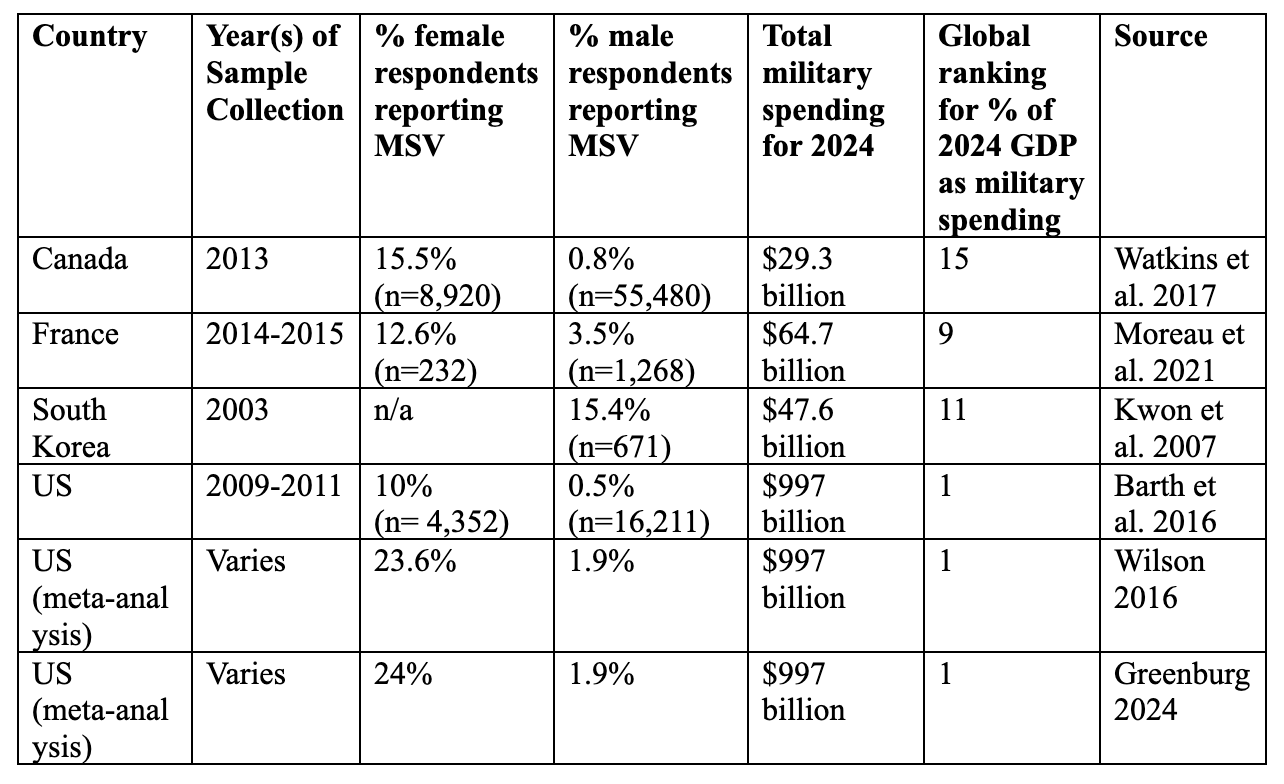
Prevalence studies with large sample sizes for reported MSV in the armed forces in Canada, France, South Korea, and the US. In accordance with national privacy laws the study on Canada was weighted; the unweighted number of respondents is n=6696 (Watkins et al. 2017). The statistics included in this table represent measures of reported physical sexual violence, of which precise definitions varied; measures of reported verbal sexual harassment are not included in this table. Military spending estimates are from the Stockholm International Peace Research Institute (SIPRI 2025).
Data on MSV likely vastly underestimates the extent of the problem due to chronic underreporting for both women and men resulting from fears of interpersonal and professional retaliation and the mishandling of their cases (Mengeling et al. 2014; Turchik and Wilson 2010). Estimates for men are likely to fall especially short; one study estimates that no more than 13% of male survivors report MSV, compared to 40% of female survivors (Swords to Ploughshares 2015, cited in Greenburg 2024, 16-17). Another study suggests that “one in three men who are sexually assaulted in the military describe the offense as hazing or bullying — twice the rate reported by women who are sexually assaulted” (Calvert and Philipps 2019).
One might object that conceptualizing MSV under the CRSV umbrella risks drifting towards “conceptual bloat” in the sense that if CRSV means everything, it means nothing. The most blatant reason to keep this issue in a separate conceptual box is that oftentimes it takes place far removed from the context of conflict itself, such as at training camps.
However, evidence suggests that it might be precisely while facing active combat that soldiers’ vulnerability to MSV increases: a US-based study identified that “[m]en reporting combat exposure had more than three times the risk for sexual assault compared with those with no combat exposure” (Barth et al. 2016, 81). Another study found that deployed women “with combat-like experiences had significantly greater odds of reporting sexual harassment or both sexual harassment and assault” (LeardMann et al. 2013, 219).
What explains MSV? Rather than constituting a weapon of war ordered from the top with the goal of advancing strategic aims, or on the opposite end of the spectrum amounting to sheer opportunism, research indicates that much CRSV better resembles what Wood calls a “practice,” which is “when commanders do not order or authorize rape but tolerate it (Wood 2018, 516; see also Cohen 2013). In terms of where this practice emerges from, feminist literature demonstrates how military cultures are constituted by a hegemonic form of masculinity which “requires and produces gender inequality” (Sjoberg and Via 2010, 10). However, it is the category of femininity as a whole which is denigrated, such that “casting the subordinated as feminine devalorizes not only the empirical gender category of women but also sexually, racially, culturally, and economically marginalized men (e.g., “lazy migrants,” “primitive natives,” “effeminate gays”) (Peterson 2010, 19).
To explain the prevalence of MSV in the US military, Wood and Toppelberg apply the theory of rape as a practice to suggest that the informal and formal socialization processes of recruits “establish sexual abuse as an appropriate punishment, including of those whose gender or sexual identities are seen as transgressing military gender norms” and promote impunity for it (Wood and Toppelberg 2018, 629-630). While some elements of US military culture appear antithetical to sexual violence, such as discipline (Titunik 2008), they nonetheless coexist with other elements which perpetuate it.
When perpetrated by members of state militaries (rather than nonstate armed groups), the problem of sexual violence is often attributed to a failure of state capacity. Yet with the world’s largest military budget, sexual violence in the US military prevails at high levels. As the author of one prevalence study concludes, “[t]he persistence of violent misogyny within military culture speaks to the difficulty of changing how gender operates within an existentially violent institution. It is also another reminder of the contradiction of achieving greater gender and racial equality within an institution whose wars contribute to global poverty and inequality around the world” (Greenburg 2024, 28).
Sexual Violence in US Black Sites during the Global War on Terror
The perpetration of sexual violence in state-run detention centers also contradicts the characterization of CRSV as a weapon of the weak. Crucially, as with MSV, evidence of this kind of sexual violence is not exclusive to resource-poor states but can also be found in contexts where security infrastructure is well-funded and technologically advanced.
The significant involvement of medical professionals in the design and implementation of torture protocols is a noted attribute of the infamous Guantánamo Bay Detention Camp (GITMO), but it was common throughout CIA-run “black sites” which cropped up during the Global War on Terror. Less noted, however, are the racial-sexual logics underlying some of these practices which reveal their function as not only a form of torture, but racialized sexual violence intended to humiliate detainees. Underscoring the sexual dimensions of what we know of the wider US torture program and recasting Abu Ghraib as a potential indicator of a wider pattern rather than a one-off further throws the merits of the US’ self-appointed leadership into question.
“Rectal feeding” and “rectal rehydration” describe the administration of an enema containing nutrients or water via the rectal cavity in situations where a patient cannot eat or drink normally. Today, enemas are not typically used for this purpose, given the scientifically demonstrated ineffectiveness of the technique compared to oral or intravenous methods, as well as their documented side effects (Barr et al. 2021).
As compellingly argued by Neel Ahuja, however, rectal feeding and rehydration regimes imposed by the CIA against detainees constitute rape conveniently concealed by medical jargon. Oftentimes, this method of torture was used against detainees when they refused food or drink (Ahuja 2020, 24-5). Ahuja’s reading of US Senate’s “torture report,” as it’s often known, demonstrates how logics of racial control based on essentialisms of Muslim and Arab masculinity shaped these practices (see also Puar 2004). Internal memos reveal how psychologists developing torture programs considered, “whether the techniques should be tailored to address specific forms of cultural resistance” (Ahuja 2020, 29).
The CIA claimed that rectal feeding and rehydration is a “well acknowledged medical technique” (Ahuja 2020, 31). But as Ahuja clarifies, while this would have been true in the 19th century, today the practice is medically obsolete. Despite this, the heavy involvement of medical and psychological professionals and the apparently extensive time and resources devoted to refining these methods of torture works to distance them from the sexual violence of “the dark ages and the history books” (Kerry 2014).
Unlike the Abu Ghraib atrocities, the violence outlined in the torture report could not be dismissed as the actions of a few “bad apples,” given the paper trail demonstrating how a preference for particular forms of torture originated within the upper echelons of the US government and were rebranded with the euphemism of “enhanced interrogation,” as illustrated in the infamous Bybee Memo (Chwastiak 2015).
However, even Abu Ghraib is rarely raised within the typology of CRSV. Of course, the sexual dimension of the torture at Abu Ghraib did not go unnoticed, and in fact saturated discussions in both the media and much of academia. Yet in advocacy from human rights NGOs on Abu Ghraib, “torture” and “prisoner abuse” are the dominant frames through which this violence is represented (see, i.e., Human Rights Watch 2004). On the other hand, during the same timeframe that the Abu Ghraib atrocities were leaked the international community was also beginning to pay attention to the violence in Eastern Democratic Republic of Congo and Darfur, where the label of sexual violence as a “weapon of war” was deployed frequently by the same organizations (see, i.e., Amnesty International 2004).
Ongoing Sexual Violence in Israeli Detention Centers
The example of Abu Ghraib additionally illustrates how applications of the CRSV label are limited not only by the form that sexual violence takes, but even more simply, by the actor accused of perpetrating it. Scholarship points to the under-acknowledgment of evidence of sexual violence perpetrated against Palestinian women, men, and children by Israeli soldiers as symptomatic of the coloniality embedded within mainstream approaches to CRSV (Madar 2023; Medien 2021; for a post-October 7 account, see Mhajne 2026). In the present moment where claims about sexual violence are being used to justify genocide, these critiques are especially salient.
Numerous accusations of sexual violence against Palestinians have been made against Israel. Notably, in March of 2025, the UN Human Rights Council received a report from the Independent International Commission of Inquiry on the Occupied Palestinian Territory, including East Jerusalem, and Israel (IICIOPT) describing what it refers to as “the systematic use of sexual, reproductive and other gender-based violence” against Palestinian women, men, and children, spanning from rape and other forms of sexual violence during arrest and detention to the impacts of starvation on pregnant and lactating women (IICIOPTl 2025).
Indicators of sexual violence by Israeli forces came prior this, however. In the initial months of Israel’s incursion into Gaza, photos circulated showing IDF soldiers posing with lingerie taken from the homes of Palestinian women (Fernández 2024; Shirbon and Grzanka 2024). Other photos, seemingly taken from far away, depict dozens of detained Palestinian men surrounded by IDF soldiers and stripped to their underwear (Salman 2023; Simon and Langfitt 2023). An IDF spokesperson told CNN those in the photos were “Hamas members and suspect Hamas members,” and were “without clothes in order to make sure they’re not carrying explosives” (Salman 2023). In 2024, human rights NGO B’Tselem published an analysis of reported deaths and torture, including sexual violence, of detained Palestinians (B’Tselem 2024).
Most recently, the Euro-Med Human Rights Monitor released its own report on sexual violence in Israeli detention centers in April of 2026. The report describes “a targeted pattern against cultural and religious identity, such as forcibly removing the hijab from female detainees, photographing them naked or half-naked, and threatening to share these images online to humiliate and socially blackmail them” (Euro-Med Human Rights Monitor 2026, 21). It alleges that perpetrators “aim[ed] to weaken the social incubator of prisoners by exploiting cultural sensitivities around ‘honour’ and ‘dignity’” (Euro-Med Human Rights Monitor 2026, 56). There are striking parallels here with the architects of the CIA torture program musing about whether they could “address specific forms of cultural resistance” (Ahuja 2020, 29) through certain torture techniques.
Israel is not the only actor in the conflict facing accusations of sexual violence. Allegations that members of Hamas perpetrated sexual violence during and after the October 7 attacks received significant media coverage. Notably, Israel invited the Office for the Special Representative to the Secretary-General on Sexual Violence in Conflict (OSRSG-SVC) to investigate these claims, marking the first time the OSRSG-SVC conducted its own independent fact-finding mission (OSRSG-SVC 2024).
Troublingly, the report released by the Human Rights Council in 2025 purports that “Israeli officials have used sexual violence committed on Israeli women on 7 October to mobilize support for the [Israeli Security Forces] military operations in the Gaza Strip and continue the war, referring to Hamas as ‘a rapist regime’” (IICIOPT 2025, 19). For example, in one statement to the Security Council, an Israeli delegate states that “[t]he demilitarization and disarmament of Hamas and the deradicalization of the Gaza Strip through education for peace and coexistence are key to ensuring that the abhorrent crimes carried out on 7 October will not be committed again against the women and girls in Israel and beyond. There will be no peace as long as children are taught to hate” (S/PV.9614 (Resumption 2), 2). A social media post from the American Israel Public Affairs Committee similarly warns: “A ceasefire now keeps these rapist monsters armed and in power in Gaza” (cited in Mhajne 2026, 115).
However, it’s not only accusations of sexual violence against Hamas which provide recourse for Israel to justify its genocide against Palestinians. The Israeli delegate continues:
As for the allegations of misconduct against Palestinians in detention mentioned in the report, those allegations have regretfully been made in a clear attempt to balance Hamas’s crimes with Israeli misconduct, as conflict-related sexual violence was never part of the conflict prior to Hamas’s brutal and atrocious attack. Nonetheless, Israel is a transparent democracy with all necessary mechanisms to evaluate any claims of misconduct. Such allegations are reviewed by Israel in accordance with the robust procedures and instruments it has in place for that purpose (S/PV.9614 (Resumption 2), 2).
Indeed, as noted by Medien (2021, 707), much of the literature on CRSV portrays the Israeli-Palestinian conflict as a context from which CRSV is notably absent. Yet Medien, Madar (2023), and Mhajne (2026) point out that this is puzzling, given the available evidence to the contrary, which indicated patterns of sexual violence in Israeli detention centers before October 7 (see, i.e., Weishut 2015). Madar (2023, 74) asks: “Why did knowledge of these cases not lead to their consideration as the tip of the iceberg in relation to what we know about Israeli state sexual violence? Why, instead of exploring the silence around Israeli state sexual violence against Palestinians, was this silence used to acquit Israel?”
In this regard, the tendency to focus disproportionately on nonstate perpetrators of CRSV has significant implications. The previous statement provided by the Israeli delegate implies that IDF-perpetrated CRSV is implausible because of Israel’s democratic institutions. Yet as the CIA torture program reminds us, when individuals are represented as inhumane, as monsters, and as fundamentally “other,” it doesn’t matter what institutions and legal protections are in place, because those “others” will be subjected to different rules.
In March of 2026, the Israeli government dropped charges against five soldiers accused of sexually violating a Palestinian detainee (Associated Press 2026). In response to the news, executive director of the Public Committee Against Torture in Israel, Sari Bashi, told the Associated Press that “‘Israel’s military advocate general just gave his soldiers license to rape – so long as the victim is Palestinian’” (Frankel 2026). This comment came shortly before the Knesset adopted a law instating mandatory death sentences for Palestinians accused of “terrorism related offenses” (Bedard 2026).
However, there are signs that Israel’s “acquittal” (Madar 2023, 74) by the international community might finally be starting to unravel. The UN Secretary-General’s most recent annual report on sexual violence in conflict, released May 29, 2026, directly attributes CRSV to Israeli forces for the first time. Annual reports from 2024 and 2025 mentioned evidence of IDF-perpetrated CRSV but did not include Israel in its annex of “parties credibly suspected of committing or being responsible for” CRSV (S/2024/292; S/2025/389). Hamas is also included in the newest list, as it was in 2025. In response to the listing, Israel stated that it would sever diplomatic ties with Secretary-General António Guterres, calling the accusation “disconnected from facts and reality” and the decision to place Hamas and Israel on the same list “unacceptable” (Livni 2026).
Reshaping Approaches to Conflict-Related Sexual Violence amidst Change and Turmoil
Despite constituting a relatively specific concern, CRSV receives disproportionate attention in policy, advocacy, and scholarship compared to problems which arguably have an even wider impact. This is in no small part, as many have remarked, due to the highly affective nature of the topic: it promotes an emotional response, is easy to sensationalize, and grabs attention more than other impacts of war typically perceived as more mundane.
Nonetheless, given this significant attention, the application of the CRSV label is highly political. CRSV is thought of, in the words of an Australian general, as “‘distinguishing between the soldier and the brute’” (Norosky 2024, 552). If CRSV represents humanity at its most depraved, then it matters greatly who is, and who is not thought to be capable of it. The examples that I have detailed here demonstrate that CRSV is not exclusively a “weapon of the weak” but rather can appear in any context which is sufficiently militarized.
Some might object that now is not the time to worry about narratives. Funding for CRSV prevention and response along with the entire WPS agenda is the most scarce it has been since global attention to this set of issues first emerged. Humanitarian aid is also stretched thin; for all the critiques which can be fairly directed at USAID, its dissolution exacerbates crises around the world as funding which many conflict-affected individuals have come to rely on is now gone. The US is also fronting an international backlash against gender work which it previously supported (Norosky 2026), which only emboldens others to contest the very legitimacy of the WPS agenda.
The immediate concern is to cope with these catastrophic effects by identifying alternative sources of funding. But it’s also clear that moving forward, the international landscape is not going back to the way it was. What form it will take remains unclear, but NGOs should begin to consider how they can leverage the WPS agenda in the absence of US leadership.
At the international level, the WPS agenda has reinforced global power dynamics and failed to challenge the militarism underlying the insecurity of women, men and children around the world. The retreat of the US from many of the global governance institutions and issue areas it once dominated will leave a power vacuum in terms of agenda-setting and leadership; the question is, who will fill it? In terms of CRSV and the WPS agenda more generally, European states need to act in equal partnership with the global majority, not “‘lead from the front,’” as one UK bureaucrat suggested (Norosky 2024, 549-550).
If there has ever been a time to challenge double standards on CRSV, it is now. While the inclusion of Israel in the Secretary-General’s CRSV “blacklist” is symbolic, it is also unprecedented; what Israel’s allies will do with this information is yet to be seen. With Israel’s staunchest backer no longer interested in setting the WPS agenda, global actors who have held their tongue have an opportunity to step up and demand accountability for the full scale of sexual harms committed, not just those perpetrated by Hamas. Failing to do so plays into Israel’s genocidal logic.
Works cited
Achilleos-Sarll, Columba. “‘Seeing’ the Women, Peace and Security Agenda: Visual (Re)Productions of WPS in UK Government National Action Plans.” International Affairs 96, no. 6 (2020): 1643–63. https://doi.org/10.1093/ia/iiaa168.
Ahuja, Neel. “Reversible Human: Rectal Feeding, Plasticity, and Racial Control in US Carceral Warfare.” Social Text 38, no. 2 (2020): 19–47.
Amnesty International. Sudan: Darfur: Rape as a Weapon of War: Sexual Violence and Its Consequences. Amnesty International, 2004. https://www.amnesty.org/en/documents/afr54/076/2004/en/.
Barr, Justin, Natalie B. Gulrajani, Alison Hurst, and Theodore N. Pappas. “Bottoms Up: A History of Rectal Nutrition From 1870 to 1920.” Annals of Surgery Open 2, no. 1 (2021): e039. https://doi.org/10.1097/AS9.0000000000000039.
Barth, Shannon K., Rachel E. Kimerling, Joanne Pavao, et al. “Military Sexual Trauma Among Recent Veterans: Correlates of Sexual Assault and Sexual Harassment.” American Journal of Preventive Medicine 50, no. 1 (2016): 77–86. https://doi.org/10.1016/j.amepre.2015.06.012.
Basu, Soumita. “The Global South Writes 1325 (Too).” International Political Science Review 37, no. 3 (2016): 362–74. https://doi.org/10.1177/0192512116642616.
Bell, Colleen, and Nicole Wegner. “Feminist Foreign Policy as a Case of Governance Feminism: Neoliberalism, Militarism, and Women as ‘Agents of Change.’” International Studies Review 27, no. 1 (2025): viaf007. https://doi.org/10.1093/isr/viaf007.
Bhattacharyya, Gargi. Dangerous Brown Men: Exploiting Sex, Violence and Feminism in the “War on Terror.” Bloomsbury Publishing, 2009.
B’Tselem. Welcome to Hell: The Israeli Prison System as a Network of Torture Camps. B’Tselem, 2024. https://www.btselem.org/publications/202408_welcome_to_hell.
Calvert, Mary F., and Dave Philipps. “Six Men Tell Their Stories of Sexual Assault in the Military.” U.S. The New York Times, September 10, 2019. https://www.nytimes.com/interactive/2019/09/10/us/men-military-sexual-assault.html.
Chung, Chin Sung. “The Origin and Development of the Military Sexual Slavery Problem in Imperial Japan.” Positions: Asia Critique 5, no. 1 (1997): 219–55. https://doi.org/10.1215/10679847-5-1-219.
Chwastiak, Michele. “Torture as Normal Work: The Bush Administration, the Central Intelligence Agency and ‘Enhanced Interrogation Techniques.’” Organization 22, no. 4 (2015): 493–511. https://doi.org/10.1177/1350508415572506.
Cohen, Dara Kay. “Explaining Rape during Civil War: Cross-National Evidence (1980–2009).” American Political Science Review 107, no. 3 (2013): 461–77. https://doi.org/10.1017/S0003055413000221.
Cunningham, Caitlin. “The Cultural Logic of Sexual Violence in Colonial Aotearoa (New Zealand), 1842–1872.” Journal of Women’s History 32, no. 2 (2020): 65–88.
Davies, Sara E., and Jacqui True. “Norm Entrepreneurship in Foreign Policy: William Hague and the Prevention of Sexual Violence in Conflict.” Foreign Policy Analysis 13, no. 3 (2017): 701–21. https://doi.org/10.1093/fpa/orw065.
Duriesmith, David. Engaging Men and Boys in the Women, Peace and Security Agenda: Beyond the “Good Men” Industry. Working Paper No. 11/2017. Centre for Women Peace and Security, London School of Economics and Political Science, 2017. http://www.lse.ac.uk/women-peace-security/publications/wps.
Eriksson Baaz, Maria, and Maria Stern. Sexual Violence as a Weapon of War?: Perceptions, Prescriptions, Problems in the Congo and Beyond. Zed Books, 2013.
Euro-Med Human Rights Monitor. “Another Genocide behind Walls”: Sexual Violence in Israeli Prisons and Detention Centres and Engineered Impunity (October 2023 - October 2025). Euro-Med Human Rights Monitor, 2026. https://euromedmonitor.org/en/article/7023/%E2%80%9CAnother-genocide-behind-walls%E2%80%9D:-Sexual-violence-in-Israeli-prisons-and-detention-centres-and-engineered-impunity-%28October-2023---October-2025%29.
Fernández, Belén. “Weaponising Underwear: Genocide with a Semi-Pornographic Twist | Israel-Palestine Conflict | Al Jazeera.” Al Jazeera, April 12, 2024. https://www.aljazeera.com/opinions/2024/4/12/weaponising-underwear-genocide-with-a-semi-pornographic-twist.
Godier, Lauren R., and M. Fossey. “Addressing the Knowledge Gap: Sexual Violence and Harassment in the UK Armed Forces.” Journal of the Royal Army Medical Corps 164, no. 5 (2018): 362–64. https://doi.org/10.1136/jramc-2017-000810.
Gray, Harriet. “The ‘War’/‘Not-War’ Divide: Domestic Violence in the Preventing Sexual Violence Initiative.” The British Journal of Politics and International Relations 21, no. 1 (2019): 189–206. https://doi.org/10.1177/1369148118802470.
Greenburg, Jennifer. Deserted: The U.S. Military’s Sexual Assault Crisis as a Cost of War. Costs of War. Watson School of International and Public Affairs, n.d. Accessed April 22, 2026. https://costsofwar.watson.brown.edu/paper/deserted-us-militarys-sexual-assault-crisis-cost-war.
Haastrup, Toni, and Jamie J. Hagen. “Global Racial Hierarchies and the Limits of Localization via National Action Plans.” In New Directions in Women, Peace and Security, edited by Laura Shepherd, Paul Kirby, and Soumita Basu. Bristol University Press, 2020. https://doi.org/10.46692/9781529207774.010.
Heath, Deana. “Torture, the State, and Sexual Violence against Men in Colonial India.” Radical History Review 2016, no. 126 (2016): 122–33. 119971190. https://doi.org/10.1215/01636545-3594469.
Ho, Sally. “Reparations Draw UN Scrutiny, but Those Who’d Pay Say Little.” Associated Press, September 28, 2021. https://apnews.com/article/united-nations-general-assembly-africa-caribbean-united-states-middle-east-7954470f191f811d6bcc65542faa6f32.
Human Rights Watch. The Road to Abu Ghraib. Human Rights Watch, 2004. https://www.hrw.org/report/2004/06/09/road-abu-ghraib.
IICIOPT. “More than a Human Can Bear”: Israel’s Systematic Use of Sexual, Reproductive and Other Forms of Gender-Based Violence since 7 October 2023. A/HRC/58/CRP.6. Human Rights Council, 2025. https://www.un.org/unispal/document/report-of-the-commission-of-inquiry-israel-gender-based-violence-13march2025/.
Kerry, John. “Remarks at The Global Summit to End Sexual Violence in Conflict.” June 13, 2024. London, United Kingdom. https://2009-2017.state.gov/secretary/remarks/2014/06/227553.htm.
Kirby, Paul. “How Is Rape a Weapon of War? Feminist International Relations, Modes of Critical Explanation and the Study of Wartime Sexual Violence.” European Journal of International Relations 19, no. 4 (2012). https://doi.org/10.1177/1354066111427614.
Kreft, Anne-Kathrin. “Civil Society Perspectives on Sexual Violence in Conflict: Patriarchy and War Strategy in Colombia.” International Affairs 96, no. 2 (2020): 457–78. https://doi.org/10.1093/ia/iiz257.
Lauro, Amandine. “Violence, Anxieties, and the Making of Interracial Dangers: Colonial Surveillance and Interracial Sexuality in the Belgian Congo.” In The Routledge Companion to Sexuality and Colonialism. Routledge, 2021.
LeardMann, Cynthia A., Amanda Pietrucha, Kathryn M. Magruder, et al. “Combat Deployment Is Associated with Sexual Harassment or Sexual Assault in a Large, Female Military Cohort.” Women’s Health Issues 23, no. 4 (2013): e215–23. https://doi.org/10.1016/j.whi.2013.05.002.
Levine, Philippa. “Modernity, Medicine, and Colonialism: The Contagious Diseases Ordinances in Hong Kong and the Straits Settlements.” In Gender, Sexuality and Colonial Modernities, edited by Antoinette Burton. Routledge Research in Gender and History. Routledge, 1999. 137359. https://research.ebsco.com/linkprocessor/plink?id=28e61d49-c615-3a7d-974d-46e9b4808ce4.
Lewis, Chloé. “The Making and Re-Making of the ‘Rape Capital of the World’: On Colonial Durabilities and the Politics of Sexual Violence Statistics in DRC.” Critical African Studies 14, no. 1 (2022): 55–72. https://doi.org/10.1080/21681392.2021.1902831.
Livni, Ephrat. “Israel to Cut Ties With U.N. Chief Over Its Inclusion on Sexual Violence Blacklist.” World. The New York Times, May 28, 2026. https://www.nytimes.com/2026/05/28/world/middleeast/israel-un-abuse-report.html.
Madar, Revital. “Beyond Male Israeli Soldiers, Palestinian Women, Rape, and War: Israeli State Sexual Violence against Palestinians.” Conflict and Society. Conflict and Society 9, no. 1 (2023): 72–88. https://doi.org/10.3167/arcs.2023.090105.
Mageza-Barthel, Rirhandu. Mobilizing Transnational Gender Politics in Post-Genocide Rwanda. Routledge, 2016. https://doi.org/10.4324/9781315595801.
Manchanda, Rita. “Difficult Encounters with the WPS Agenda in South Asia: Re- Scripting Globalized Norms and Policy Frameworks for a Feminist Peace.” In New Directions in Women, Peace and Security, edited by Laura Shepherd, Paul Kirby, and Soumita Basu. Bristol University Press, 2020. https://doi.org/10.46692/9781529207774.010.
Medien, Kathryn. “Israeli Settler Colonialism, ‘Humanitarian Warfare,’ and Sexual Violence in Palestine.” International Feminist Journal of Politics 23, no. 5 (2021): 698–719. https://doi.org/10.1080/14616742.2021.1882323.
Meger, Sara. “The Fetishization of Sexual Violence in International Security.” International Studies Quarterly 60, no. 1 (2016): 149–59. https://doi.org/10.1093/isq/sqw003.
Meger, Sara. “Toward a Feminist Political Economy of Wartime Sexual Violence: The Case of the Democratic Republic of Congo.” International Feminist Journal of Politics 17, no. 3 (2015): 416–34. https://doi.org/10.1080/14616742.2014.941253.
Meiu, George Paul. “Colonialism and Sexuality.” In The International Encyclopedia of Human Sexuality. John Wiley & Sons, Ltd, 2015. https://doi.org/10.1002/9781118896877.wbiehs004.
Mengeling, Michelle A., Brenda M. Booth, James C. Torner, and Anne G. Sadler. “Reporting Sexual Assault in the Military: Who Reports and Why Most Servicewomen Don’t.” American Journal of Preventive Medicine 47, no. 1 (2014): 17–25. https://doi.org/10.1016/j.amepre.2014.03.001.
Mertens, Charlotte. “In the Ruins of Empire: Historicizing Sexual Violence in Congo.” International Feminist Journal of Politics 25, no. 3 (2023): 529–50. https://doi.org/10.1080/14616742.2023.2198546.
Mertens, Charlotte. “Undoing Research on Sexual Violence in Eastern Democratic Republic of Congo.” ACME: An International Journal for Critical Geographies 18, no. 3 (2019): 3. https://doi.org/10.14288/acme.v18i3.1594.
Mhajne, Anwar. “Understanding Sexual Violence Debates Since 7 October: Weaponization and Denial.” Journal of Genocide Research 28, no. 1 (2026): 103–21. https://doi.org/10.1080/14623528.2024.2359851.
Mohanty, Chandra. “Under Western Eyes: Feminist Scholarship and Colonial Discourses.” Feminist Review 30, no. 1 (1988): 61–88. https://doi.org/10.1057/fr.1988.42.
Moreau, Caroline, Dina Bedretdinova, Sandrine Duron, et al. “From Sexual Harassment to Sexual Assault: Prevalence and Correlates of Sexual Trauma in the French Military.” PLOS ONE 16, no. 11 (2021): e0259182. https://doi.org/10.1371/journal.pone.0259182.
Musina, Daniela. “Militarising Gender: A (Contrapuntal) Reading of Women, Peace and Security (WPS) Applications in EU-Tunisian Security Assemblages.” European Security 32, no. 3 (2023): 464–84. https://doi.org/10.1080/09662839.2023.2233961.
Norosky, Jenna. “Distinguishing between the ‘Soldier’ and the ‘Brute’: Engraving Hierarchies of Masculinity in Conflict-Related Sexual Violence Discourse.” International Feminist Journal of Politics 26, no. 3 (2024): 544–65. https://doi.org/10.1080/14616742.2024.2345097.
Norosky, Jenna. “How Debate about Gender Identity Could Undermine Global Efforts to Protect Victims of Violence.” The Conversation, April 14, 2026. https://doi.org/10.64628/AAI.gkw7yhpm5.
NPR. “Journalist Fights To Give Voice To Congo Victims.” National Public Radio, November 16, 2009. https://www.npr.org/2009/11/16/120452678/journalist-fights-to-give-voice-to-congo-victims.
Oruh, Chioma Mary. “Imperialism, Rape and the Congo Predicament.” Ph.D., Howard University, 2015. https://www.proquest.com/docview/1712659250/B1B65B434EF6437APQ/2?accountid=14572.
OSRSG-SVC. Official Visit of the Special Representative of the Secretary-General on Sexual Violence in Conflict to Israel and the Occupied West Bank - 29 January – 14 February 2024 - Mission Report. Office of the Special Representative of the Secretary-General on Sexual Violence in Conflict, 2024. https://www.un.org/unispal/document/mission-report-official-visit-of-the-office-of-the-srsg-svc-4mar24/.
Peterson, V. Spike. “Gendered Identities, Ideologies, and Practices in the Context of War and Militarism.” In Gender, War, and Militarism: Feminist Perspectives, edited by Laura Sjoberg and Sandra E. Via. Bloomsbury Publishing, 2010.
Puar, Jasbir. “Abu Ghraib: Arguing against Exceptionalism.” Feminist Studies 30, no. 2 (2004): 522–34. https://doi.org/10.2307/20458978.
Salman, Abeer. “Images from Gaza Show Israeli Soldiers Detaining Dozens of Men Stripped to Underwear | CNN.” CNN (December 7, 2023), n.d. Accessed April 22, 2026. https://www.cnn.com/2023/12/07/middleeast/gaza-israeli-soldiers-detained-men-intl.
Scott, James C. Weapons of the Weak: Everyday Forms of Peasant Resistance. Yale University Press, 1985. https://www.jstor.org/stable/j.ctt1nq836.
Scully, Pamela. “Rape, Race, and Colonial Culture: The Sexual Politics of Identity in the Nineteenth-Century Cape Colony, South Africa.” The American Historical Review 100, no. 2 (1995): 335–59. https://doi.org/10.2307/2169002.
Shepherd, Laura J. “Making War Safe for Women? National Action Plans and the Militarisation of the Women, Peace and Security Agenda.” International Political Science Review 37, no. 3 (2016): 324–35. https://doi.org/10.1177/0192512116629820.
Shepherd, Laura J., and Jacqui True. “The Women, Peace and Security Agenda and Australian Leadership in the World: From Rhetoric to Commitment?” Australian Journal of International Affairs 68, no. 3 (2014): 257–84. https://doi.org/10.1080/10357718.2014.903895.
Shirbon, Estelle, and Pola Grzanka. “Israeli Soldiers Play with Gaza Women’s Underwear in Online Posts.” Middle East. Reuters, March 28, 2024. https://www.reuters.com/world/middle-east/israeli-soldiers-play-with-gaza-womens-underwear-online-posts-2024-03-28/.
Simon, Scott, and Frank Langfitt. “Images Showing Israeli Soldiers Stripping and ‘humiliating’ Palestinians Spark Outrage.” Middle East. NPR, December 9, 2023. https://www.npr.org/2023/12/09/1218386048/images-showing-israeli-soldiers-stripping-and-humiliating-palestinians-spark-out.
Sjoberg, Laura, and Sandra Via. “Introduction.” In Gender, War, and Militarism: Feminist Perspectives, edited by Sandra Via and Laura Sjoberg. Bloomsbury Publishing, 2010.
Smith, Andrea. Conquest: Sexual Violence and American Indian Genocide. Duke University Press, 2015.
Smith, Andrea. “Not an Indian Tradition: The Sexual Colonization of Native Peoples.” Hypatia 18, no. 2 (2003): 70–85.
Smith, Toni. “Liberators or Perpetrators? Co-Opting, Committing, and Condoning Sexual Violence against Women and Girls in the Early Belgian Congo.” Slavery & Abolition 43, no. 2 (2022): 366–93. https://doi.org/10.1080/0144039X.2022.2063235.
Spivak, Gayatri Chakravorty. “Can the Subaltern Speak?” In Marxism and the Interpretation of Culture, Reprint edition. University of Illinois Press, 1988.
Swords to Ploughshares. Military Sexual Trauma: Understanding Prevalence, Resources and Considerations to Care. Swords to Ploughshares, 2015. https://www.swords-to-plowshares.org/research-publications/military-sexual-trauma-understanding-prevalence-resources-and-considerations-to-care.
Titunik, Regina F. “The Myth of the Macho Military.” Polity 40, no. 2 (2008): 137–63. https://doi.org/10.1057/palgrave.polity.2300090.
Turchik, Jessica A., and Susan M. Wilson. “Sexual Assault in the U.S. Military: A Review of the Literature and Recommendations for the Future.” Aggression and Violent Behavior 15, no. 4 (2010): 267–77. https://doi.org/10.1016/j.avb.2010.01.005.
UN Department of Peacekeeping Operations. “Addressing Conflict-Related Sexual Violence: An Analytic Inventory of Peacekeeping Practice.” New York: UN Women, UN Action Against Sexual Violence in Conflict, 2010.
UN Security Council. “6984th Meeting of the Security Council.” United Nations, 2013. S/PV.6984. Security Council. https://docs.un.org/en/S/PV.6984.
UN Security Council. “7428th Meeting of the Security Council.” United Nations, 2015. S/PV.7428. Security Council. https://docs.un.org/en/S/PV.7428.
UN Security Council. “7704th Meeting of the Security Council.” United Nations, 2016. S/PV.7704. Security Council. https://docs.un.org/en/S/PV.7704.
UN Security Council. “Conflict-related sexual violence: Report of the Secretary-General.”
United Nations, 2024. S/2024/292. Security Council. https://docs.un.org/en/s/2024/292.
UN Security Council. “Conflict-related sexual violence: Report of the Secretary-General.”
United Nations, 2025. S/2025/389. Security Council. https://docs.un.org/en/S/2025/389.
Vihervalli, Ulriika. “Wartime Rape in Late Antiquity: Consecrated Virgins and Victim Bias in the
Fifth-Century West.” Early Medieval Europe 30, no. 1 (2022): 3–19. https://doi.org/10.1111/emed.12520.
Watkins, Kimberley, Rachel Bennett, Mark A. Zamorski, and Isabelle Richer. “Military-Related Sexual Assault in Canada: A Cross-Sectional Survey.” Research. CMAJ Open 5, no. 2 (2017): E496–507. https://doi.org/10.9778/cmajo.20160140.
Weishut, Daniel J. N. “Sexual Torture of Palestinian Men by Israeli Authorities.” Reproductive Health Matters 23, no. 46 (2015): 71–84. https://doi.org/10.1016/j.rhm.2015.11.019.
Wilson, Laura C. “The Prevalence of Military Sexual Trauma: A Meta-Analysis.” Trauma, Violence & Abuse 19, no. 5 (2018): 584–97. https://doi.org/10.1177/1524838016683459.
Wood, Elisabeth Jean. “Rape as a Practice of War: Toward a Typology of Political Violence.” Politics & Society 46, no. 4 (2018). https://doi.org/10.1177/0032329218773710.
Wood, Elisabeth Jean. “The Persistence of Sexual Assault within the US Military.” Journal of Peace Research 54, no. 5 (2017). https://doi.org/10.1177/0022343317720487.
Wright, Hannah. “‘Masculinities Perspectives’: Advancing a Radical Women, Peace and Security Agenda?” International Feminist Journal of Politics 22, no. 5 (2020): 652–74. https://doi.org/10.1080/14616742.2019.1667849.
Wright, Hannah, and Columba Achilleos-Sarll. “Towards an Abolitionist Feminist Peace: State Violence, Anti-Militarism, and the Women, Peace and Security Agenda.” Review of International Studies, June 3, 2024, 1–19. https://doi.org/10.1017/S0260210524000354.
Yang, Hyunah. “Finding the ‘Map of Memory’: Testimony of the Japanese Military Sexual Slavery Survivors.” Positions: East Asia Cultures Critique 16, no. 1 (2008): 79–107.
More
Research
The Growing BRICS+: A New World Order?


